



Case Studies
Useful Worksite Knowledge
The paper bag discharged from the bag-opening equipment is the “health certificate.”
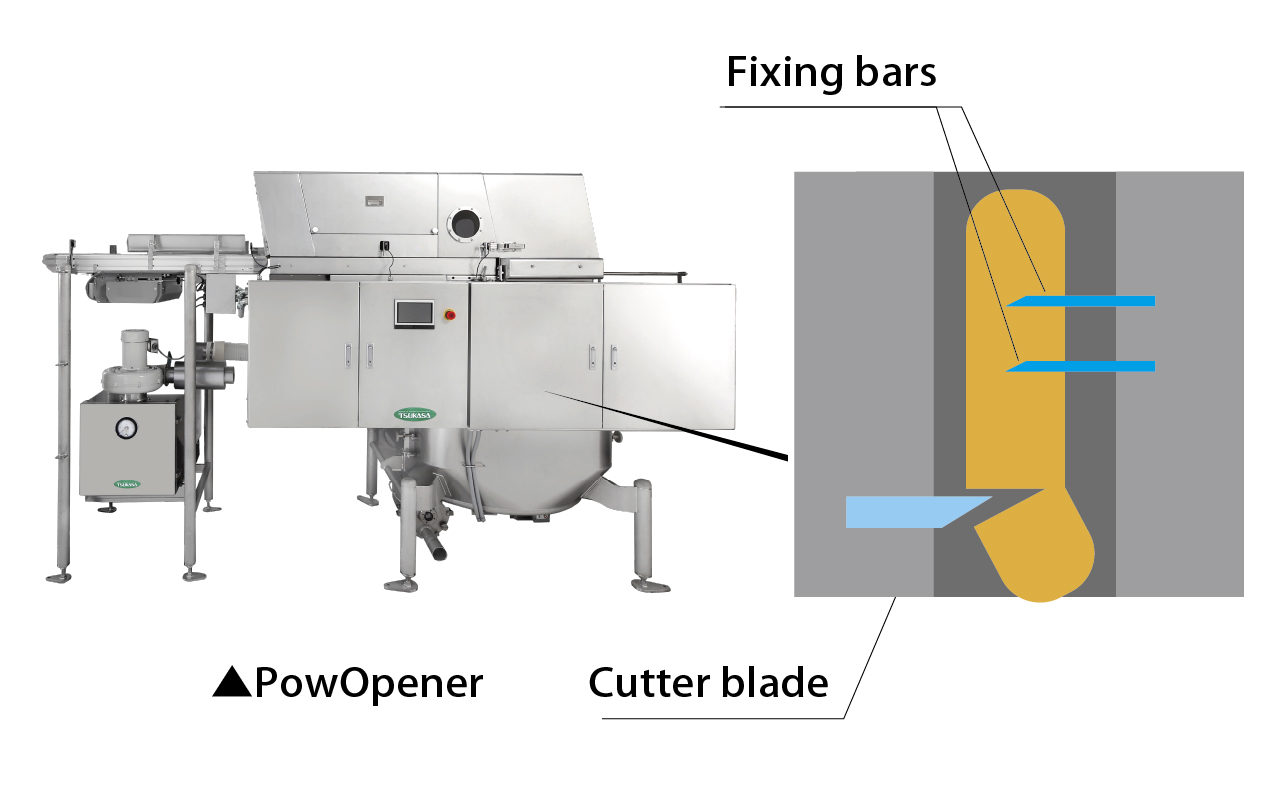
The PowOpener (automatic bag-opening equipment) mechanically opens raw material bags and continuously discharges their contents, causing wear and tear on the parts in contact with the bags. Regular inspections are of the utmost importance, and here are some simple checkpoints you can perform as part of your daily operations.
Signs of wear and tear you can identify without calling an expert
There is an inspection method that operators who use the PowOpener on a daily basis can put into practice right away. That is, “checking the condition of the paper bag after processing.”
By analyzing the patterns of cuts and tears in the bags, you can grasp which consumable parts are approaching their limits.
By analyzing the patterns of cuts and tears in the bags, you can grasp which consumable parts are approaching their limits.
Take a closer look at the condition of the paper bag after processing!
① Check the cuts on the bottom and sides of the bag
There are snagged marks, the cut edges are jagged, and it looks as if it has been torn. → Abrasion and decreased sharpness of the cutter blade

② Check the upper half of the bag (the area where the needle is pricked)
The needle marks have caused large tears, and paper fragments are likely to form. → Crushing of the tip of the fixing bars

Why does this happen?: Mechanisms by component
[Abrasion of the cutter blade]
The cutter blade wears down each time you cut a paper bag. When the blade becomes dull, instead of “cutting” the bag, it ends up “tearing” it, resulting in jagged edges or snagged marks.
[Crushing of the tip of the fixing bars]
A fixing bar is a component that pierces the end of a bag to secure it in place. If the tip is crushed, it will not penetrate the bag deeply enough, resulting in inadequate securing. As a result, the bag moves around violently, leading to tears and paper fragments. The formation of paper fragments poses a direct risk of foreign matter contamination in food manufacturing facilities.
What do you do if you find abnormalities with a paper bag?
Cutter blades: Sharpen or replace the blades (Decide based on the situation)
Fixing bars: Check the tips for deformations and replace them if necessary
These are all consumable parts, and they are designed to be replaced on a regular basis. If you notice anything unusual about the condition of the bag, please contact TSUKASA.
A paper bag that has been processed is a sign that the bag-opening equipment is telling you, “I’m on my last leg.” Make sure you understand the condition thoroughly and keep your equipment in good working order.